Scientists Identify a New Bear Dog Species Found in Spain
The Story
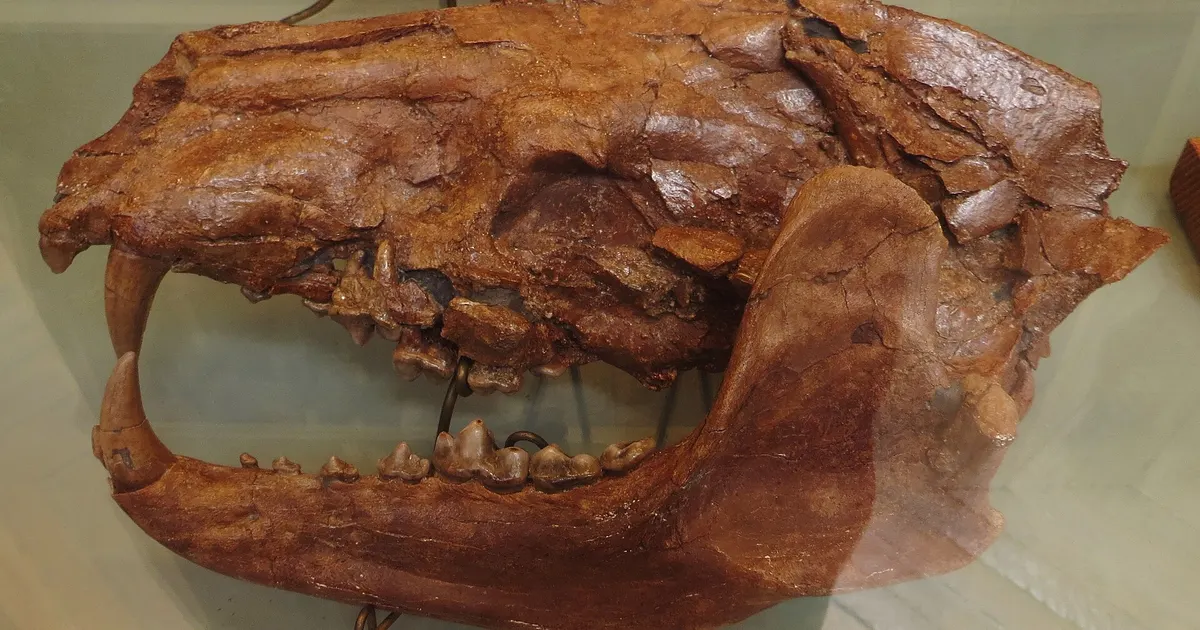
Paleontologists have identified Paludocyon moyasolai, a previously unknown species of amphicyonid or ancient bear dog, from two fossils unearthed at the els Casots site near Barcelona, Spain, dating to roughly 15.9 million years ago during the Middle Miocene epoch.
The animal once roamed a warm, forested landscape dotted with shallow lakes, and researchers set it apart by its unusual molar proportions, including a second upper molar broader than the first and an exceptionally large, well developed third upper molar.
The specimens consist of a compressed but well preserved partial skull with most of its teeth intact plus an isolated lower molar, both now held at the Institut Català de Paleontologia Miquel Crusafont in Sabadell.
A team led by Dr. Jorge Morales of Spain's Museo Nacional de Ciencias Naturales compared its dental features with related species across Europe and North America.
The phylogenetic analysis places Paludocyon moyasolai as the earliest branch of its genus, marking it one of the most primitive known bear dogs and suggesting that the genus Cynelos does not form a single natural evolutionary grouping.
Published in the Journal of Mammalian Evolution, the discovery deepens understanding of amphicyonids, formidable land predators that ranged across North America and Eurasia for much of the Cenozoic Era.
The animal once roamed a warm, forested landscape dotted with shallow lakes, and researchers set it apart by its unusual molar proportions, including a second upper molar broader than the first and an exceptionally large, well developed third upper molar.
The specimens consist of a compressed but well preserved partial skull with most of its teeth intact plus an isolated lower molar, both now held at the Institut Català de Paleontologia Miquel Crusafont in Sabadell.
A team led by Dr. Jorge Morales of Spain's Museo Nacional de Ciencias Naturales compared its dental features with related species across Europe and North America.
The phylogenetic analysis places Paludocyon moyasolai as the earliest branch of its genus, marking it one of the most primitive known bear dogs and suggesting that the genus Cynelos does not form a single natural evolutionary grouping.
Published in the Journal of Mammalian Evolution, the discovery deepens understanding of amphicyonids, formidable land predators that ranged across North America and Eurasia for much of the Cenozoic Era.
Why It Matters
A skull unearthed at Els Casots near Barcelona spent decades misidentified in storage until a 2014 doctoral thesis noticed something wrong, and the animal inside proved new to science, Euronews recounts. Paludocyon moyasolai lived about 15.9 million years ago in what was then a warm, shallow lake country, grew to large dog size at 50 to 70 kilograms, and is known from a compressed partial skull retaining most of its teeth. The complication runs through taxonomy: the study finds the older genus Cynelos paraphyletic, meaning museum drawers sorted under the old assumptions hold species that are not all kin. Excavations resumed in 2018 and continue, with a second, larger bear dog at the site still awaiting description Phys.org.
Go Deeper
Read the original reporting at Sci.News.
Read Full Story at Sci.News →