Why Webb Needs a Giant Sunshield to See
Trill News Original
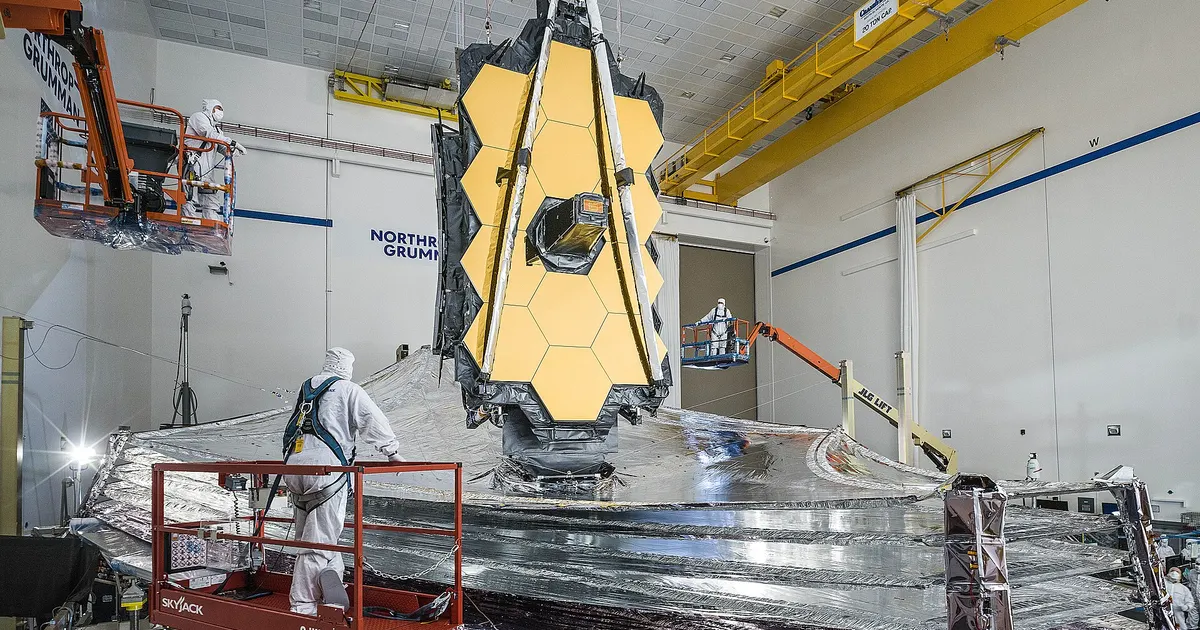
Webb’s gold mirror gets the portraits. The enormous sheet beneath it does much of the work that makes those portraits possible. An infrared observatory has to keep its own warmth from interfering with the faint light it was built to measure. A bigger mirror cannot, on its own, solve that problem.
That is the engineering argument behind Webb’s five layered sunshield. NASA describes it as a barrier separating sensitive optics from the heat of the Sun, Earth, Moon and the observatory’s own equipment. The telescope has to control what reaches its instruments as carefully as it collects the light it wants. NASA’s sunshield explanation puts thermal control at the center of the design.
The telescope can become its own interference
Infrared light sits beyond the red end of the visible spectrum. It offers astronomers access to things an ordinary visible light image can miss: relatively cool objects, stars forming inside dusty regions, and distant galaxies whose light has stretched as the universe expanded. Those are different scientific reasons for using the same broad part of the spectrum. Infrared astronomy is more than taking a normal photograph and giving it unusual colors.
The difficulty is that the observatory also emits radiation associated with its temperature. Sensitive measurements need that unwanted contribution kept under control. NASA’s infrared astronomy guide explains what the desired light can reveal. The implication for readers is straightforward: a telescope’s usefulness depends on the signal it can distinguish, not simply the light it can gather.
Astronomers studying a dim object lose when the instrument adds an overwhelming foreground of its own. The hardware must make room for the observation before software can help interpret it. This is why the sunshield belongs in the story of Webb’s discoveries, even when it does not appear in the final image.
Five layers leave heat somewhere to go
Webb’s shield is roughly the size of a tennis court. Its membranes are thin, separated layers, rather than a thick insulating blanket wrapped around the telescope. The reflective coatings and the spacing work together to reduce the heat reaching the cold side. Keeping layers apart also limits direct heat transfer between them.
The arrangement has an important consequence: protection requires an escape route for unwanted energy. The telescope’s open structure lets heat radiate into space. Enclosing the cold optics in a warm tube would introduce another source of infrared radiation. NASA’s cooling explanation connects the shield, the open structure and the separation of warm spacecraft equipment from cold scientific instruments.
It is tempting to imagine the shield as ordinary shade scaled up. The comparison gets only part of the way there. Webb needs a stable thermal environment as well as a cold one. Changes in temperature can change the dimensions of structures and disturb precise alignment. A telescope designed to measure faint light cannot treat its own temperature as background housekeeping.
Its orbit makes the shield useful
A flat shield cannot protect an observatory from every direction at once. Webb’s location helps keep the major sources of heat on the protected side. It travels around the Sun near the second Sun and Earth Lagrange point, called L2, about 1.5 million kilometers from Earth.
Webb does not sit motionless on an invisible pin at L2. It follows an orbit around that region and uses small corrections to maintain its trajectory. The geometry allows the Sun, Earth and Moon to remain in the same general direction relative to the shield. NASA’s orbit description also explains why the observatory’s path avoids passing through Earth’s and the Moon’s shadows.
The location and the shield therefore solve parts of the same problem. Choosing an orbit is not merely choosing an address for a finished telescope. It shapes the conditions in which the instrument can work. Judging the shield without the orbit would be like judging a roof without knowing where rain comes from.
One instrument still needs a refrigerator
Passive cooling does not meet every requirement. Webb’s Mid Infrared Instrument, MIRI, measures longer wavelengths than its near infrared instruments and needs especially cold detectors. Its dedicated cryocooler brings them below 7 kelvin, only a few degrees above absolute zero.
The system moves heat using a closed circuit of helium. It does not work like a tank of coolant that must steadily be emptied to keep the instrument cold. Its operation instead depends on functioning pumps and electronics. NASA’s cryocooler account describes another constraint: vibration from the cooling machinery must be minimized so it does not shake the optics and blur measurements.
There is no single trick that makes the observatory cold enough. Some requirements can be met by blocking incoming heat and allowing radiation to escape. Others demand powered equipment. The design combines them because scientific instruments have different operating needs, even when they share one telescope.
Read the engineering before comparing the pictures
Webb still needs a large collecting mirror. Its segmented structure allows a large optical surface to fit inside a launch vehicle and unfold afterward. The shield also had to be packed and deployed. NASA’s telescope overview makes clear that collection, temperature control and launch constraints had to be solved together.
That offers a better way to read news about another observatory, including Roman’s journey toward its observing orbit. Ask which light it measures, what scientific question it serves, and what could interfere with that measurement. Comparing mirror sizes alone leaves out the conditions that make the collected light useful.
The next impressive image will show the target rather than the engineering surrounding it. Before treating the picture as a triumph of magnification, look for the quieter achievement: the observatory kept enough of its own interference out of the way to let a faint object speak.