Why the Roman Lycurgus Cup Changes Color
Trill News Original
The Lycurgus Cup looks green with light falling on its surface and red with light passing through it. Tiny metal particles inside the glass produce this effect, known as dichroism. The Roman vessel rewards a closer look for another reason: its figures stand clear of the bowl in a carved glass cage. Both achievements are real. Claims that its makers understood modern nanotechnology go further than the evidence allows.
What is the Lycurgus Cup?
The British Museum dates the cup to the fourth century and identifies its decoration as scenes of the death of King Lycurgus. Its collection record lists a maximum diameter of 132 millimeters, about the width of a large grapefruit. This is an object made to be encountered at close range, where a viewer can follow the figures around its curved surface. The museum catalogs both glass and silver among its materials; the metal rim and foot visible in photographs belong to the object’s history, too. British Museum collection record
The subject connects a luxury vessel with a story about the god of wine. In the museum’s account, Lycurgus attacks Dionysus and his followers. Ambrosia appeals to Mother Earth, becomes a vine, and traps the king. The entwining plant is therefore part of the action, rather than a border added around a portrait. The museum describes the cup in the setting of Roman banqueting. Read that setting alongside the myth and the decoration becomes easier to follow: the king has picked a fight with the very god associated with the gathering. British Museum gallery guide
Why does the cup change color?
The position of the light matters. With the lamp and viewer on the same side, the glass appears green; with the lamp behind it, transmitted light appears red. A photograph showing one arrangement cannot demonstrate the other. The comparison requires keeping track of where illumination enters and where the viewer receives it. The red appearance does not require a red liquid inside the vessel. Kool and colleagues’ optical comparison
Researchers identified minute particles of a silver and gold alloy in the glass, typically 50 to 100 nanometers across. The 2007 study by Ian Freestone and colleagues explains how those particles support the color effect and reviews the earlier microscopy. Their size and distribution matter alongside the metals present. Listing gold and silver as ingredients is therefore an incomplete recipe: the resulting structure must also interact with light in the required way. Freestone and colleagues, 2007
How was the glass cage made?
A cage cup puts open space between its decoration and its container. Corning Museum of Glass describes these vessels as cut from thick glass blanks, leaving figures, letters, or meshes attached to the body by small supports. The cutter removes material to expose the pattern. That gives the eye two surfaces to follow: the outer design and the vessel behind it. Corning’s survey of Roman cage cups
Think about the difference between drawing a vine on a cup and freeing a glass vine from the surrounding material. In the second case, each opening needs an edge, and the remaining connections must hold the ornament in place. The empty spaces carry much of the visual effect. Corning’s definition of undercutting describes precisely this removal of glass between the body and its raised decoration. Corning glass dictionary
Comparison also prevents an easy mistake about function. A separate fourth century cage cup in Corning’s collection retains metal suspension fittings. The museum interprets that vessel as probably a hanging lamp. This does not establish that the Lycurgus Cup was a lamp; it shows why the name of a vessel is insufficient to settle how every example was used. Shape, attachments, context, and decoration each supply different evidence. Corning cage cup, accession 87.1.1
Did Romans knowingly invent nanotechnology?
Nanoparticles are a description of the surviving material. They cannot by themselves tell us what an artisan knew. Freestone and colleagues caution that makers probably lacked close control over metal concentrations and particle growth, and may not have understood gold’s contribution. They discuss accidental discovery as a possibility. The earlier version of this article overstated the evidence by saying the mixture proved exact knowledge and ruled out accident. The research supports skilled glassworking while leaving the discovery process uncertain. The study’s discussion of production
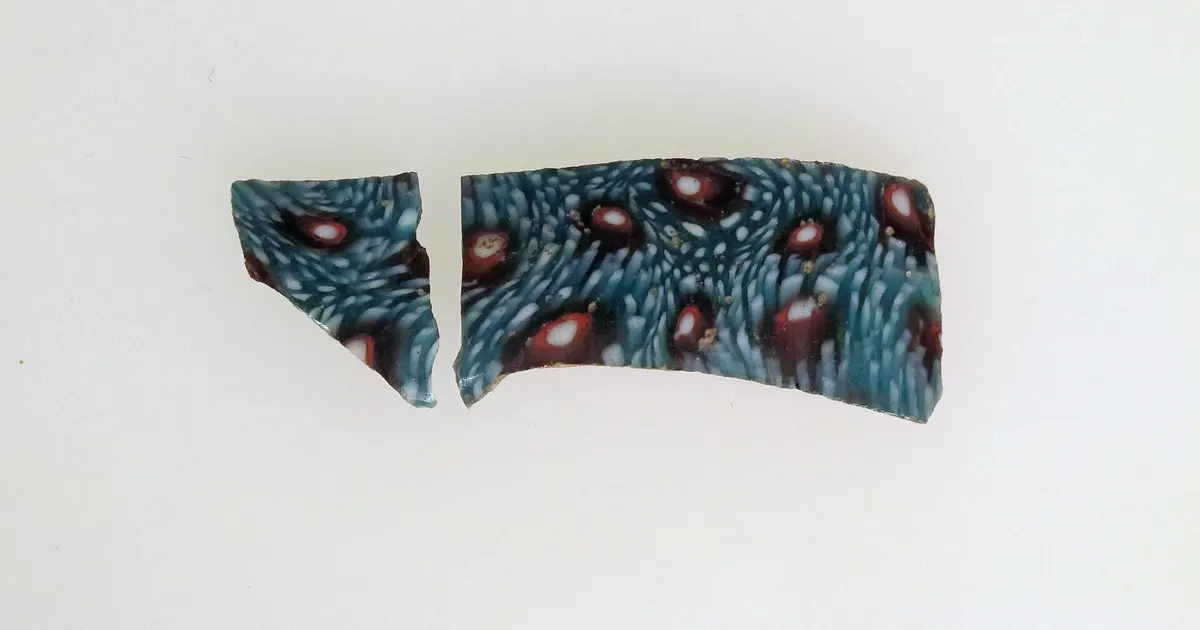
Nor does the cup stand completely alone as evidence of unusual Roman glass. Corning catalogs a fragment dated to the fourth century that appears olive green under one lighting condition and violet in transmitted light. It is a fragment, with a different appearance, rather than another intact Lycurgus Cup. Its value is comparative: a broken object can preserve information about a technique even when its original vessel is lost. Corning dichroic fragment, accession 78.1.17
What can modern experiments establish?
In 2020, Lars Kool and colleagues reported a material containing silver and gold nanoparticles that they could use in 3D printing. Their composite reproduced the green and red dichroic appearance. It used a polymer material, so matching the visible effect did not recreate a Roman glass workshop or prove its recipe. The experiment establishes a modern route to a similar optical result. The research team’s methods and results
That distinction makes the cup more useful to look at. Ask three separate questions: what the light does, how the carved structure was produced, and what evidence survives about the maker’s choices. A convincing answer to one does not automatically answer the others. For more objects examined through their materials and historical setting, explore the Trill News visual art coverage.