Why Plato and Aristotle Made Music Part of Education
Trill News Original
A school timetable is an argument about what people are for. Aristotle made that argument openly when he asked why music belonged in education at all. It did not earn a living or help run a household, as reading and writing did. His answer was that an education should prepare a citizen for the hours when no work is required, and that how a person spends those hours matters more than the work itself.
Plato reached music from another direction. In the Republic, his Socrates puts music first in the training of an imagined city’s guardians, because what children hear shapes what they will later love. Both philosophers treated music as serious public business. Both also designed their programs for a narrow class, the guardians of an imagined city in one case and free citizens in the other, and their case for music is hard to separate from the people it left out.
Four subjects and one hard case
Book VIII of Aristotle’s Politics, in Benjamin Jowett’s translation, opens with a demand that the education of citizens be “one and the same for all” and public rather than left to each household. It then reports that “the customary branches of education are in number four”: reading and writing, gymnastic exercises, music and, sometimes, drawing.
Three of the four justify themselves easily in his account. Reading and writing serve money-making, household management and political life. Drawing helps a person judge the work of artists. Gymnastic is thought to instill courage. Music is the problem, and Aristotle says so: most people of his day cultivate it for pleasure.
He also draws a line around useful knowledge. Children should learn necessary skills, he argues, but not anything that makes a free person less fit for virtue. He counts “all paid employments” as vulgar, “for they absorb and degrade the mind.” That judgment matters later. A curriculum built to keep students away from wage work assumes someone else is doing it.
Leisure was the point
Aristotle’s case for music turns on leisure. Music was originally included, he writes, because “nature herself” requires that we be able “not only to work well, but to use leisure well.” He goes further: “the first principle of all action is leisure.” Work exists for the sake of something else. Leisure, properly used, is where happiness lives.
He separates leisure from amusement. Amusement is a medicine for the fatigue of work, he says, and belongs at suitable times. It cannot be the purpose of life. The ancestors, in his telling, “admitted music into education, not on the ground either of its necessity or utility,” but as a way for a free man to spend his leisure well. A few lines later he puts it bluntly: “To be always seeking after the useful does not become free and exalted souls.”
Then he complicates his own case. Children cannot yet enjoy the intellectual pleasure that is the goal, and “learning is no amusement, but is accompanied with pain.” So why teach music to the young? Because, he argues, rhythm and melody contain likenesses of anger, gentleness, courage and temperance. A young person who learns to take pleasure in good music is practicing the habit of “rejoicing and loving and hating aright.” He prescribes the Dorian mode as the steady middle and keeps the music modest.
Players, not professionals
Aristotle also asks why anyone should learn to play when others could perform. His answer is practical: “It is difficult, if not impossible, for those who do not perform to be good judges of the performance of others.” Students should be taught “not only critics but performers,” then may stop performing as adults.
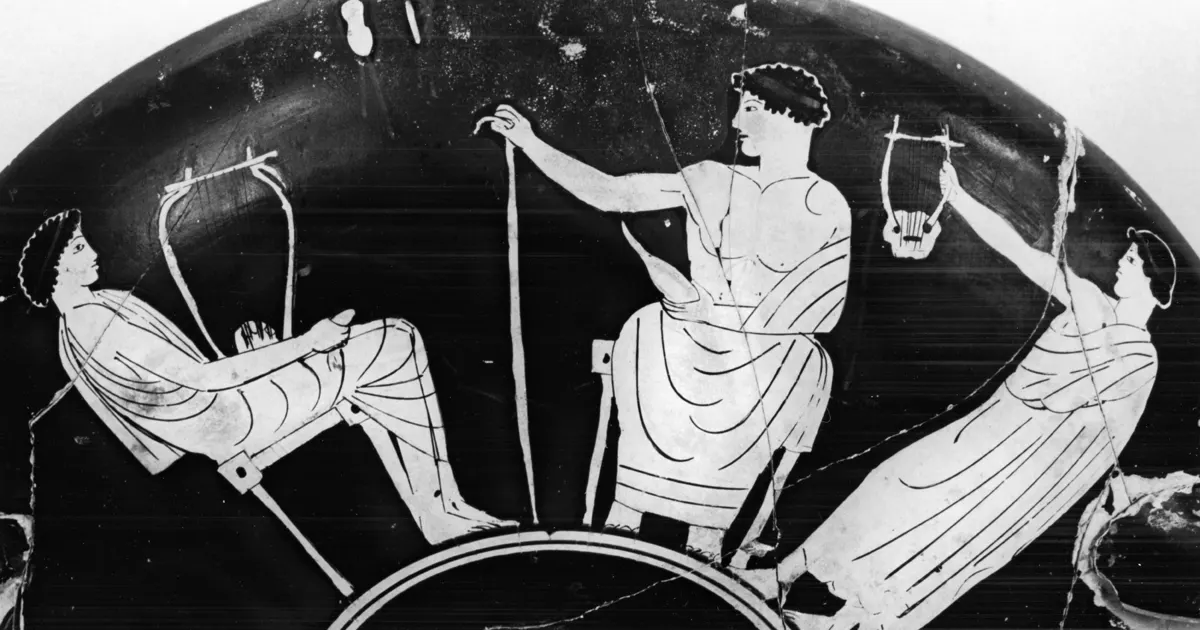
Yet he wants them to stop well short of virtuosity. Training should not aim at the showpiece skills of professional contests. He rejects the aulos, which Jowett translates as “the flute,” as too exciting and too demanding, and complains that it prevents the player from singing. Readers should not picture a modern concert flute. Armand D’Angour, an Oxford classicist, describes the popular aulos as two double-reed pipes played at once, sounding like a pair of powerful oboes.
Aristotle’s objection is about status as well as sound. He says professional performance makes performers vulgar, because they play to please an audience rather than to improve themselves. He even divides theater audiences into the “free and educated” and “a vulgar crowd composed of mechanics, laborers, and the like,” who should get their own contests and their own, lesser, music.
Plato’s Socrates begins with stories
The Republic is a dialogue, not a school manual. Its speakers imagine founding a city, and the educational program belongs to that thought experiment. In Book II, Socrates proposes the traditional pairing of “gymnastic for the body, and music for the soul.” Asked by Socrates whether music includes literature, his companion Adeimantus answers, “I do.” D’Angour notes elsewhere that most classical Greek poetry was composed to be sung to the lyre or aulos, which helps explain why Socrates can treat stories as part of music.
Since children hear stories before they can train their bodies, Socrates starts there, and his first move is control. He calls for “a censorship of the writers of fiction” and asks mothers and nurses to tell only approved tales. Stories of gods fighting, deceiving or causing evil are to be cut, because a young person “cannot judge what is allegorical and what is literal.”
Book III extends the control to melody and rhythm. With Glaucon supplying the technical names, Socrates bans the modes linked to lament and to softness, keeping only the Dorian and Phrygian. Many-stringed instruments go, the flute goes, and “the lyre and the harp” remain in the city, with a pipe for shepherds. The reason is the strongest claim either philosopher makes for music: “rhythm and harmony find their way into the inward places of the soul.”
Socrates does not treat music as automatically good. A life of nothing but soft song, he warns, melts a person’s spirit; a life of nothing but exercise makes one brutal. The aim is a balance of the two. Aristotle, who knew the dialogue, disagreed on details. “The Socrates of the Republic is wrong,” he writes, to keep the Phrygian mode alongside the Dorian while rejecting the flute, since in his view the Phrygian is to the modes what the flute is to instruments.
Whose freedom the curriculum served
The two programs differ in emphasis. Aristotle stresses judgment and the worthy use of leisure; Plato’s Socrates stresses shaping character through what the young absorb. They share an assumption: music educates the people who will rule, fight and deliberate.
Book III of the Politics makes the boundary explicit. Aristotle writes that “no man can practice virtue who is living the life of a mechanic or laborer,” and that the best form of state will not admit such workers to citizenship. Leisure, in this scheme, belonged to some people because others worked. As the philosopher C. D. C. Reeve observes in Aeon, the constitutions Aristotle preferred freed citizens for lifelong education by having most of the labor done by enslaved people.
That history does not settle what schools should teach now, and these texts are philosophical prescriptions, not a census of what every Greek child learned. Their lasting challenge is the question underneath. When a budget treats music as optional, it makes a claim about what education is for. When Aristotle insisted on it, he made one about who deserved a life beyond work. A curriculum that defends free time should also say whose free time it means.